My Polymarket Journey
I Thought Polymarket Weather Markets Were a Data Problem. I Was Wrong.
At the beginning of January, I became interested in Polymarket.
What attracted me was not just gambling or speculation. It was the idea that markets could become a new kind of information system. As Polymarket’s founder, Shayne Coplan, has put it, Polymarket is not just a betting platform, but something closer to “News 2.0”, a way to turn questions about current events into useful probabilities.
That was exactly what attracted me in the beginning.
It felt like a new kind of news platform, where the headline was not an opinion, but a probability. If you had better information, better judgment, or a better way to process public data, maybe you could turn that into an edge.
I looked at many types of markets.
Politics is not my thing. I had no insider information either. Crypto felt too manipulated. I did not want to play a game with unclear and unfair rules.
Then I found weather markets, and that opened my eyes, because the weather data was public. The outcomes were measurable (I thought). The rules seemed objective. Forecasts, models, historical data, station readings, everything was out there.
If I did it right, I felt I could build my own informational edge. It also matched my background perfectly. I had been working with data for almost ten years, and this looked like a place where my skills could actually matter.
So I started digging.
Like everyone else, I first started by checking weather forecasts. Around that time, Google’s WeatherNext 2 had just been released, and Google was presenting it as faster, more accurate, and higher-resolution. That made the timing feel even more right.
I started collecting forecast data from many sources: Google Weather, Open-Meteo, national weather services such as the Met Office for London, KMA for Korea, and any other source I could find.
I used my data engineering experience to build a solid pipeline. I also used my mathematical background, my bachelor’s degree was in mathematics, to create my own prediction logic. The goal was to estimate probabilities for different temperature outcomes.
This was the part I understood well. Data pipelines, APIs, mathematics, probability, this felt like home ground. I was no longer just a random trader clicking buttons. I was building a system.
When everything was ready, I sold some of my crypto as my initial trading capital and started trading. At the beginning, it worked. I was lucky. Very lucky. The first few days went surprisingly well. I was making something like 10% per day. At one point, I felt like I was not just making money, I was printing money.
Of course, deep down, I knew it would not stay that smooth. I was prepared for that.
Then the market taught me the first lesson.
One day, in a London temperature market, the actual result moved against my prediction by around two degrees. That single miss wiped out not only all the profit I had made so far, but also part of my original capital.
I tweaked the model, refined the strategy, and ran it for another couple of days. The same pattern happened again: first, some profit. Then another incident. Then the profit was gone.
That was the first real shock.
But I did not quit. I’m no quitter!
I sat back and realized something important: these forecasts might be accurate at the area or district level, but Polymarket weather markets are not really about area-level weather. They often resolve based on one single station, at one single point. Basically, it is one sensor. And anything can happen to that sensor.
That made me question my whole approach. And I started to think, was there another way to trade these markets without relying so heavily on weather forecasts?
I know my own personality. I am not really a gambler. Compared with making big bets on unlikely buckets and hoping for a huge win, I prefer safer trades, even if the margin is very thin. Losing money really hurts me more compared to winning less.
So I started thinking about a new strategy. Instead of trying to predict the exact winning bucket myself, maybe I could use the market itself as information.
I downloaded a lot of historical Polymarket transaction data and market data. At one point, I had collected more than 200GB of data.
Since forecasts were not always accurate, maybe I did not need to build the perfect forecast model. Maybe I could simply look at how the market was pricing each bucket, understand where other traders were placing their bets, and buy NO on buckets that seemed almost impossible to become the final winning bucket.
The margin would be thin, but I thought I would not lose money. That led me to a concept I called the “modal bucket.” The modal bucket was the bucket with the highest YES price. In other words, it was the bucket the market believed was most likely to resolve as the final result.
My idea was simple. If the modal bucket was 10°C, then the nearby buckets, 10°C, 9°C, 8°C, maybe 7°C, were still dangerous. They were close enough to the center that the final result could easily drift into them.
But buckets much farther away from the modal bucket looked much safer to bet against.
So instead of buying YES on the bucket that might win, I started buying NO on buckets that were far away from the modal bucket.
I was no longer trying to guess the exact winning bucket. I was simply trying to identify buckets that were unlikely to win. The farther a bucket was from the modal bucket, the safer it seemed.
I used all the data I had collected to backtest and analyze this idea. I even spun up a team of AI agents acting as data analysts and quant traders, and asked them to evaluate and test the strategy. The conclusion was that it might be profitable.
With smart capital deployment, I could reuse the same money multiple times per day. For example, I could buy Asian markets first. When those markets resolved, I could reuse the same capital for European markets, and then later for American markets. So even if the margin per event was thin, the capital could compound multiple times per day.
At that moment, I thought I was a freaking genius.
So I went ahead, built my trading engine, and turned this strategy into a bot.
But the weakness of the strategy was easy to see. The margin was tiny, but the risk was huge.
I might be risking 99.5 cents to win only 0.5 cents. To make meaningful profit, I needed to buy a significant number of shares. That made the exposure even larger.
But I was under pressure. I needed to move forward. So I deployed the strategy and let it run.
Once again, it worked for a while. For a couple of weeks, things looked good. Then, not surprisingly, incidents happened again.
And I lost a lot. I mean, really a lot.
That hurt.
I started doubting myself. I doubted my capability. I doubted my intelligence. But I was still not ready to quit.
I told myself I should fight again.
After taking a short break, I decided to study how successful traders were actually doing this.
Yes, in some sense, it was copying.
At first, I did not like the idea of copying other traders. It felt like cheating. I wanted to build my own strategy. But after losing money, I started studying profitable traders more seriously.
I looked at what they traded, when they entered, when they exited, how they picked buckets, and what trading techniques they used.
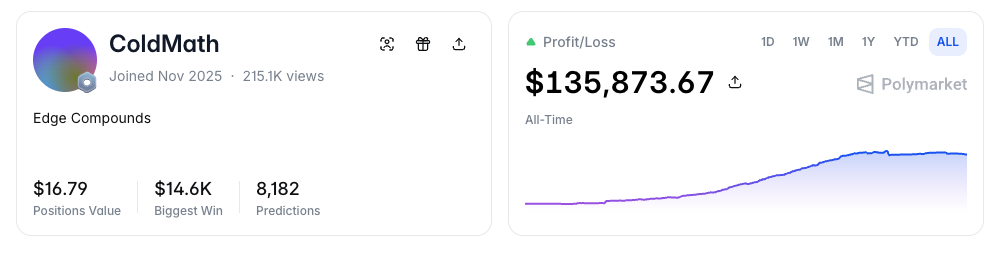
One trader I analyzed deeply was ColdMath, an absolute legend in weather markets. I spent a lot of time studying his trades, and in a strange way, it felt like he is my soul mate. Off topic, I strongly believe he is Finnish, his trading behavior matches my “stereotype” of Finns: quiet, patient, extremely disciplined, and when the opportunity appears, just no hesitation.
I also had the chance to talk to some traders who were making profits. They told me they also used forecast data. That encouraged me. I thought maybe the ultimate answer was still to improve my forecast model further.
So I did that. Once again, with more learning and experience, I entered the market.
And once again, it went well at the beginning.
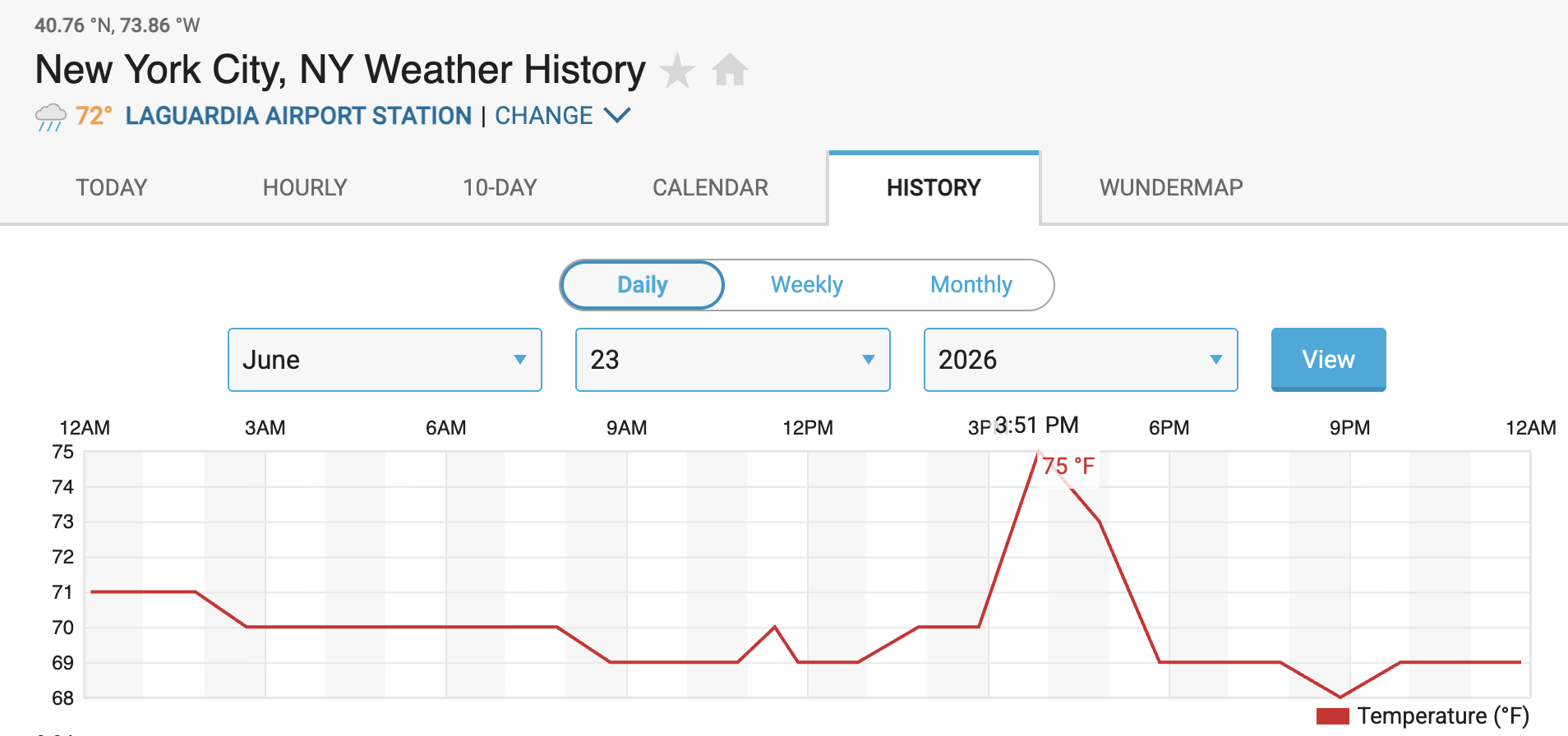
Then the NYC incident happened. On June 23, all the forecasts said the temperature would go down from around 71°F to somewhere near 64°F. There seemed to be no possible way it could suddenly move much higher. But that is exactly what happened. At one single data point, the temperature jumped to 75°F.
That destroyed my portfolio.
It reminded me of the “hair-dryer guy” in Paris(for those who do not know, there was a man used a hair dryer to heat up the sensor, and moved up the temperature a lot, and he was caught on camera, and later sentenced for several years in prison). These absurd-looking temperature spikes feel almost impossible, but they still show up in the data and decide the market.
That was when I realized another important thing.
I had thought profit would come from a good trading strategy and a good trading engine. But in reality, we also have to deal with the resolution data source.
And in many cases, that source is Weather Underground, or WU.
WU is an old weather data site, and in my experience, it is not always stable or reliable enough for this kind of usage. A lot can happen. Data points can be revised or edited. Sometimes there may be no data sent to WU for several hours during the day, and so on and so on.
In my opinion, it is irresponsible for Polymarket to use WU as the single resolution source for weather markets. If they wanted to make the market more fair, they could use multiple sources, including METAR data, as part of the resolution process.
But they did not. And maybe they will not. Maybe the uncertainty makes the markets more “fun” and “flexible.” But for a trader, it brings another layer of risk.
So besides trading strategy and trading engine, we also have to deal with incidents, exceptions, and source risk.
That made me realize the game was incomplete for me.
It also made me realize that my personality might not be a good fit for this type of trading.
That was when I decided to quit.
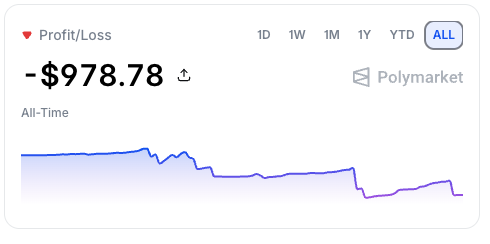
Of course, there must still be other ways to move forward. There are traders who do make money. I am not saying the market is impossible.
But I realized it was no longer worth my time.
My time and talent belong somewhere else.
There is no need to tie myself to one tree. There are plenty of other opportunities.
And I did learn a lot. I learned about weather data, forecast models, market resolution, order books, backtesting, trader behavior, and risk.
I also learned something more personal: when you are desperate to make money, your judgment becomes weaker. You start seeing what you want to see. You mistake early luck for skill. You keep adding complexity because it feels like progress, even when the real issue may be risk control.
My Polymarket journey started with a simple belief:
Public data can become private alpha if you process it better than others.
I still think there is some truth in that.
But now I would add another sentence:
An edge is not real unless it survives execution, liquidity, risk, and emotion.
That is the real lesson I took from this journey.
And that is also why Polymarket is so interesting and dangerous at the same time.
When you are only reading Polymarket, it can feel like information.
When you are trading it, it becomes risk.